Creative tools for people who think without pictures

Free exercises and plain-language answers, no signup.

Try a Creative Exercise

Select your medium and available time to generate a non-visual exercise.

1. Choose Medium
2. Choose Time
Writing • Target: 10 mins

Facts first, then the scene

You don't need to see a place to write it. Build it from what is true about it.

Steps to follow:

  1. Pick a place your character is standing in. Don't try to see it.
  2. List eight facts about it: three sounds, two physical sensations, two things someone might say, and one thing that doesn't belong.
  3. Circle the three that interest you most.
  4. Write one paragraph that moves through those three in order, one sentence each, with a connecting sentence between them.
  5. Read it aloud. Cut any line that only says what something looks like unless the story needs it.
View standalone page ›

Questions & Explanations

Plain-language answers about creativity, imagination, and aphantasia.

What aphantasia is

Aphantasia is the inability to voluntarily create mental images. The term was introduced by researchers in 2015. Some people have always had it (congenital) and some acquire it later, for example after an illness or injury. Researchers estimate that roughly 4 percent of people have some form of it. It also varies a lot: for some, other senses such as sound are affected too, and for others only sight is. It sits on a spectrum of imagery, and many people only find out in adulthood because there's nothing obvious to notice. This is general information, not medical advice.

Creating without picturing

Aphantasia doesn't mean no imagination. A mind can build new things through sound, words, structure, movement or by working directly on something real. A useful way to look at it is task by task: does what you're attempting require generating an image from nothing, or can you work on something that already exists? The first kind is often a struggle. The second can be where people with aphantasia do very well, because there's no internal image competing with the real one. Ask what a task needs you to do in your head, then find an outside version of that step.

CJ Stewart's book explores this idea chapter by chapter.

Finding which channel is open

People with aphantasia differ in which internal senses still work. Some can hear music or words clearly in their head even with no visual imagery. Others have little internal imagery in any sense and work through real-time feel and reaction instead. You can test yourself: hum a phrase that doesn't exist yet and notice whether it arrives before you make it or only as you do. Try the same with a texture, a movement or a list of words. Which approach feels natural is useful information about where to aim your creative work.

Imagery versus working memory

Researchers treat visual imagery (conjuring a picture on demand) and visual working memory (holding and manipulating something that's actually in front of you) as separate systems. Aphantasia usually involves the first one. Some studies suggest the second can remain intact, or even compensate, in people with aphantasia, with accuracy kept but a different strategy used. In practice, many people with aphantasia find editing, collage or live production easier than producing an image from scratch. The research is still developing, so treat it as a useful lead and not a guarantee.

Drawing and painting

Drawing from memory asks you to hold an image in mind and match it with your hand, which is exactly what's hard with aphantasia. It isn't a lack of talent. Practical routes include drawing from a reference, tracing or projecting an image, working abstractly in color and shape, or starting from a photo and changing it. One study found that people with aphantasia struggled to reproduce specific objects from memory but kept their sense of layout. Using a reference isn't a lesser way to make art, since the canvas doesn't know how the image got there.

CJ Stewart's book covers his own painting and tracing workarounds.

Using AI image tools as a reference

If you can describe a scene in words but can't see it, an image generator can make the picture for you to work from. Describe what you want, generate a few options, then treat the result like any reference photo: choose, annotate, adjust and build from it. This gives you the step that most people do in their heads. It doesn't replace your own taste or craft, and it isn't required to be creative with aphantasia, but it adds one more way to make an idea exist outside your head.

Process over destination

If you can't see a finished piece in your head, you can't chase it, so some people with aphantasia end up working by response: make a mark, listen to it, make the next decision. That shifts the creative focus from outcome to process. You can use it on purpose. Set a timer, decide nothing in advance, and make each choice from the one before it. Let the piece show you what it is. Many people find it takes pressure off, since there's no gap between a mental image and the real result to feel bad about.

Confidence and ability

Research has documented what's been called a confidence gap in aphantasia: people may rate their performance lower than it objectively is, assuming missing imagery must cost them something. At the same time, one large study found no significant difference in how aphantasic and typical participants rated their own artistic ability, and a meaningful share of the aphantasic participants worked in artistic fields. If you catch yourself assuming you're worse, check it against actual evidence, such as your results or other people's feedback, before accepting it.

Memory and keeping things

Many people with aphantasia know facts about their past but can't replay it as images, and some research suggests emotional recall can feel more subdued. One practical response is to anchor memory outside your head: journal, keep photos, write things down, record voice notes. They do the job that mental replay does for other people, and they're also material you can create from later. If memory or emotional distance is troubling you personally, a professional can help with that, and this is general information, not medical advice.

Video and filmmaking

Planning shots without picturing them is workable. Describe each shot in plain sentences, then create or collect a reference for each one: stills from films, stock photos, a sketch or an AI-generated image. Annotate the camera position, framing and light. Editing and live switching rely on reacting to footage that already exists, which many people with aphantasia find comfortable and precise. Pair the plan with sound notes if sound is a strong channel for you.

CJ Stewart's book draws on his career in video production and live visuals.

Checking where you fall

A common self-check is the Vividness of Visual Imagery Questionnaire (VVIQ), developed by David Marks. You score how clear your mental pictures are for a series of specific scenes, on a scale from crystal clear to nothing at all. It's free to find online. It's a self-report tool, which has limits, and it isn't a medical diagnosis, but it's a good starting point. Imagery runs on a spectrum from none (aphantasia) to extremely vivid (hyperphantasia), and most people are somewhere in the middle. You don't need a formal label to start trying ways of working that don't rely on mental pictures.

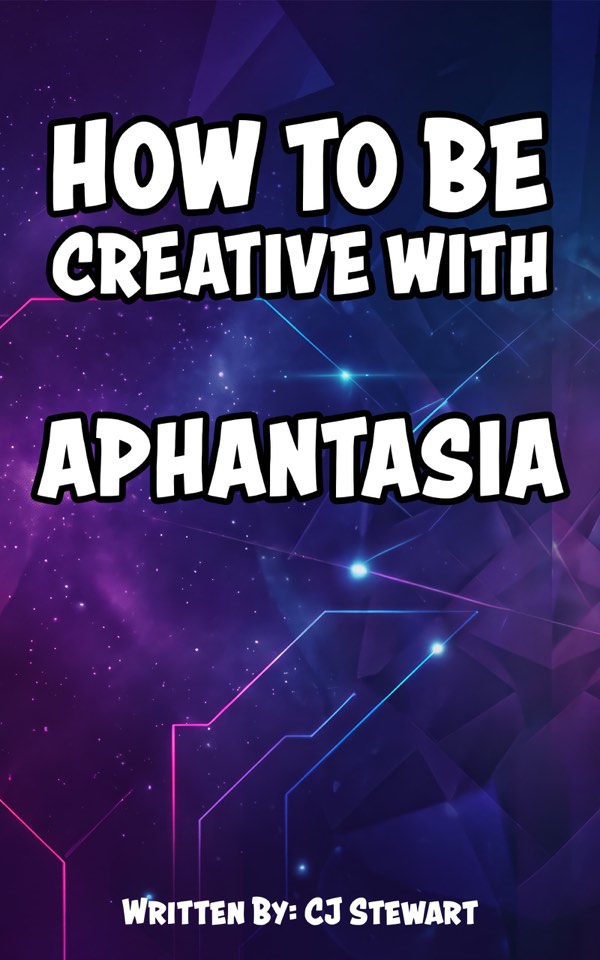
Cover of How to Be Creative with Aphantasia
Recommended Reading

How to Be Creative with Aphantasia

by CJ Stewart

A working account of how creativity happens when the mind's eye isn't there. CJ Stewart, a lifelong musician, painter, VJ and video producer who learned he had aphantasia in his forties, walks through the creative channels that stayed open for him (sound, working on real material, live and immediate work, and AI-generated references) and ends each chapter with something you can try. It is a practical, personal book, not a medical one.